




Handmade vs Machine-Made Rugs: How to Tell the Difference

Two rugs can look almost the same in a photo and still be very different pieces. One may be hand-knotted over many months and last for generations. The other may come off a power loom in a few hours. Both have a place in a home. This guide explains how each type is made, how to tell them apart, and what the difference means for price and wear.
Three ways a rug is made
Hand-knotted
A weaver ties each knot by hand around the vertical warp threads, row by row, and packs each row down with the weft. A good-sized Persian rug can hold hundreds of thousands of knots and take months to finish. Because the pile is locked into the foundation, a well-made hand-knotted rug can last for generations. This is how traditional Persian and Oriental rugs are made. See our Persian and Oriental collection.
Handwoven flatweave
Kilims are woven by hand on a loom too, but with no knots and no pile. The coloured weft threads form the pattern, so most kilims can be used on both sides. Browse our kilim and flatweave rugs.
Hand-tufted
A hand-held tool pushes yarn through a canvas backing. The back is then glued and covered with a cloth. Tufted rugs are made by hand, but faster than knotted rugs, and the glued backing usually limits their lifespan.
Machine-made
Power looms weave the rug from wool, polypropylene, polyester or viscose. Machine-made rugs are consistent, affordable and quick to produce. Modern machine-made Persian designs bring a traditional look to a room at a lower price. See our modern and contemporary rugs.
How to tell them apart in one minute
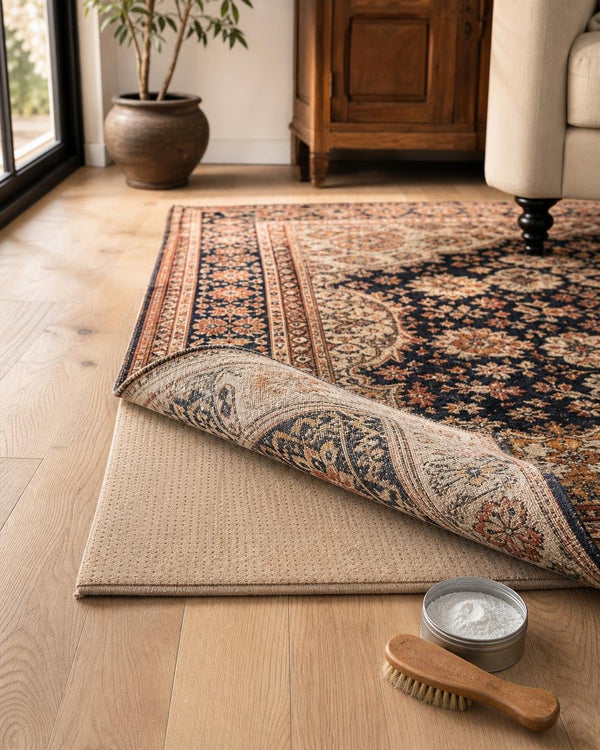
- Turn the rug over. On a hand-knotted rug, the pattern shows clearly on the back and you can see small irregularities in the knots. A machine-made back looks very even. A tufted rug has a cloth or glued back.
- Look at the fringe. On a hand-knotted rug, the fringe is the end of the warp threads, so it is part of the rug. On many machine-made and tufted rugs, the fringe is sewn or glued on afterwards.
- Check the pattern. Handmade rugs have small changes in colour (called abrash) and slight differences from side to side. Machine-made rugs are almost perfectly symmetrical.
- Feel the edges. The sides of a hand-knotted rug are wrapped by hand. Machine-made edges are usually overlocked by machine and look very uniform.
Which one is right for you?
Choose handmade if you want a piece that holds its value, can be cleaned and repaired for decades, and has the character of a person's work. Browse all handmade rugs, including antique and collectible rugs.
Choose machine-made if you want a specific look at a lower price, need several matching rugs, or are furnishing a busy family room, a rental or a patio. Our outdoor rugs are machine-made for sun and moisture.
Want a handmade rug at a lower price? Look at our refurbished Persian rugs. They are pre-owned, handmade pieces that we clean and restore in our own workshop.
Common questions
Are machine-made Persian rugs "real" Persian rugs?
They copy Persian designs, but they are not hand-knotted and are usually not made in Iran. They are a good way to get the look. They do not hold value like a handmade piece.
Do handmade rugs cost more?
Usually, yes. The price reflects the months of work, the quality of the wool or silk, and the knot density. Read our guide on how to value a Persian rug.
Want to see the difference in person? Visit our showroom at Unit 1, The Straight Shopping Centre, 78 The Straight Avenue, Fourways. Call 011 467 3747 or WhatsApp 066 114 8411.
